Nikon SLM Solutions AG 2026


There’s a moment in every technology’s lifecycle when it stops being a curiosity and starts being a competitive advantage. For additive manufacturing, that moment is now, and nowhere is it more visible than at Bosch’s facility in Nürnberg, where a strategic partnership with Nikon SLM Solutions has turned industrial-scale 3D printing into a genuine serial production capability.
A Facility Built for the Future of Manufacturing
What Bosch has built in Nürnberg is not a lab. It is a fully operational, automotive-grade production environment. Within just eight months of a strategic decision to invest in a new facility, the site was producing its first parts, a timeline that speaks to the depth of planning, the quality of the partnership, and the maturity of the technology involved.
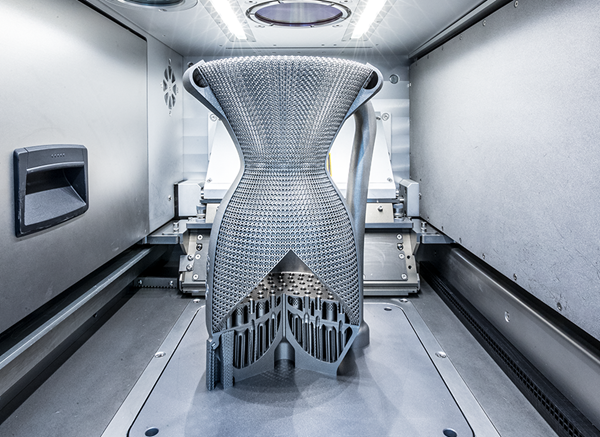
The centerpiece of the facility is the NXG XII 600, a 12-laser system engineered for high-productivity metal AM. With the ability to produce up to 100 parts of significant size in a single build job, the NXG XII 600 is not a prototyping machine. It is a production system. It sits within a complete process chain that includes post-processing, machining, sampling, and quality assurance, giving Bosch everything required for full serial output under one roof.
The Technology: Precision at Industrial Scale
The process at the heart of the operation is selective laser beam melting, a micro-welding technique that fuses metal powder layer by layer into fully dense, structurally sound components. The result is parts that match or exceed the mechanical properties of conventionally manufactured equivalents. In testing, 3D-printed components have demonstrated tensile strength equal to or better than die-cast counterparts, with heat treatment processes used to align ductility and achieve the precise material properties demanded by automotive applications.
Crucially, the facility operates to automotive serial production standards, not development tolerances. Full traceability is maintained across the entire process chain, and the quality systems in place reflect decades of Bosch’s engineering expertise applied directly to the AM environment. This is manufacturing at the level the automotive industry demands, delivered through a technology that, until recently, was considered unsuitable for it.
Competing on Cost, Speed, and Flexibility
One of the most significant shifts that AM enables is the elimination of tooling. Traditional casting requires weeks or months of tooling preparation before a single production part can be made. With the NXG XII 600, there is no tooling. The laser and the coater are the only tools required, and they can produce any geometry the design calls for. This has a profound impact on time to market.
At Bosch’s Nürnberg facility, the go-to-market time for new components has been reduced by approximately 75%. For a company where speed of iteration during development is a strategic priority, this is transformative. New product designs can be tested, refined, and validated in a fraction of the time previously required, with each iteration cycle taking days rather than months.
The economics are equally compelling. The NXG XII 600’s higher laser density and building rate allow Bosch to compete on price against classical manufacturing methods, including milling, drilling, and casting, at a worldwide scale. For parts where geometry, weight reduction, or part consolidation deliver additional value, the case for AM becomes even stronger.
Lightweighting, a persistent priority across automotive and adjacent sectors, is a natural strength of additive design. So is part integration: by combining multiple components into a single printed part, assembly complexity is reduced and potential failure points, such as leakages in fluid or gas systems, are eliminated. This is particularly significant in emerging application areas such as hydrogen compression, where Bosch has already produced components on the NXG that would be difficult or impossible to manufacture conventionally.
A Partnership Built on Shared Standards
What makes the Nürnberg facility more than a technology showcase is the nature of the relationship between Bosch and Nikon SLM Solutions. This is not a standard equipment purchase. It is a strategic partnership with shared objectives, shared development roadmaps, and a shared commitment to raising the standards of industrial AM.
Nikon SLM Solutions provides not just the machine, but the process parameters for different powder materials, ongoing technical coaching, and 24/7 support. The two organizations are working together to reduce preventive maintenance time and increase machine uptime, a critical factor for a facility running serial production schedules. When Bosch encountered technical challenges in the early stages, Nikon SLM was on-site to guide, validate, and accelerate the learning curve.
The result is an ecosystem that benefits both sides. Bosch brings over a century of automotive manufacturing expertise and one of the most demanding quality standards in any industry. Nikon SLM Solutions brings cutting-edge laser melting technology and a deep technical knowledge of the AM process. Together, they are developing what both organizations describe as a new industry standard for high-quality, high-productivity additive manufacturing.
Scaling Across the Product Lifecycle
One of the most strategically important aspects of Bosch’s AM program is its applicability across the entire product lifecycle, not just in development, but through serial production and into aftermarket.
In the development phase, AM enables rapid design iteration and fast time to market. In serial production, the technology’s scalability allows output volumes to be adjusted in real time to match customer demand, a significant advantage in markets where volumes are increasingly variable and unpredictable. Unlike casting, which only becomes cost-efficient at high volumes, AM is economically viable from a single part. This opens the door to genuinely on-demand manufacturing.
In the aftermarket and product ramp-down phases, this on-demand capability becomes even more valuable. Rather than maintaining inventory stock for low-volume part numbers, Bosch can print exactly what is needed, when it is needed. It is a business model shift as much as a technology shift, and one that is already operational in Nürnberg.
The Road Ahead
The facility in Nürnberg currently operates as the first line in what Bosch plans to expand into a broader AM production environment. Space has been reserved for additional lines, and the strategy is clear: to grow the volume of parts produced additively, serve both internal business units and external customers, and continue developing the partnership with Nikon SLM Solutions to push productivity, automation, and cost efficiency further.
Awareness and capability within Bosch’s engineering community is growing. More designers are learning to think in terms of what additive manufacturing makes possible, including geometries, integrations, and design freedoms that conventional methods cannot offer. As that knowledge base deepens, the pipeline of applications suitable for AM serial production will continue to expand.
What is being built in Nürnberg goes beyond parts. It is a model for how the world’s most demanding manufacturers can integrate additive manufacturing into their core operations, not as a supplement to conventional production, but as a fully competitive, fully scalable alternative. The future of customized, on-demand, automotive-grade manufacturing is not on the horizon. It is already running in Nürnberg.